Artisan Bread Recipe – Easy Homemade Crusty Loaf Recipe
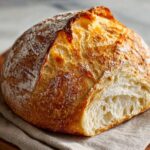
This artisan bread recipe guides you through making an easy homemade crusty loaf with a chewy interior and a golden-brown crust, perfect for beginners wanting to bake bakery-quality bread at home.
- Prep Time: 20 minutes
- Cook Time: 45 minutes
- Total Time: 2 hours 50 minutes
- Yield: 1 loaf 1x
- Category: Bread
- Method: Baking
- Cuisine: American/Artisan
- Diet: Vegetarian
Ingredients
Units
Scale
Ingredients
- 3 cups (395 grams) all-purpose flour or bread flour
- 1/2 tablespoon kosher salt
- 1/4 ounce instant or active dry yeast packet (or 2 1/4 teaspoons)
- 1 1/2 cups warm water (105°F)
- Olive oil or cooking spray (for greasing bowl)
Instructions
- Activate yeast: In a large mixing bowl, combine warm water and yeast. If using active dry yeast, let sit for 5-10 minutes until foamy. If using instant yeast, it can be added directly to dry ingredients.
- Combine ingredients: Add flour and salt to the yeast mixture. Stir until just combined, forming a shaggy, sticky dough. Do not add more flour at this stage.
- Knead the dough: Turn dough onto a lightly floured surface. Knead for 8-10 minutes until smooth and elastic. The dough should spring back slowly when poked.
- First rise: Place dough in a lightly greased bowl, turning to coat. Cover and let rise in a warm, draft-free spot for 1 to 1.5 hours, or until doubled in size.
- Shape the loaf: Gently punch down dough and shape into a round boule or your desired rustic shape on a lightly floured surface. Create surface tension by tucking edges underneath.
- Second rise and baking: Place shaped loaf on parchment-lined baking sheet. Cover loosely and let proof for 30-45 minutes. Preheat oven to 450°F (230°C). For a crusty exterior, bake in a preheated Dutch oven, covered, for 20 minutes, then uncovered for another 20-25 minutes until deep golden brown.
- Cool the bread: Transfer baked loaf to a wire rack to cool completely before slicing. This allows the crumb structure to set properly.
Notes
- Use warm water (105°F) to activate the yeast properly.
- Do not add extra flour during initial mixing to keep dough sticky and develop gluten structure.
- Allow dough to rise in a warm, draft-free spot to ensure proper fermentation.
- Cooling the bread completely before slicing helps the crumb set and improves texture.